Abhijay Ghildyal

I am an Applied Scientist II at Microsoft, working in the IC3-AI team. I recently completed my Ph.D. in Computer Science at Portland State University's Computer Graphics and Vision Lab, where I was fortunate to be advised by Dr. Feng Liu.

Previously, I was a Machine Learning Researcher at Sony Interactive Entertainment (PlayStation) and an Applied Scientist Intern on Amazon's Imaging Science team.

Research
NOVA
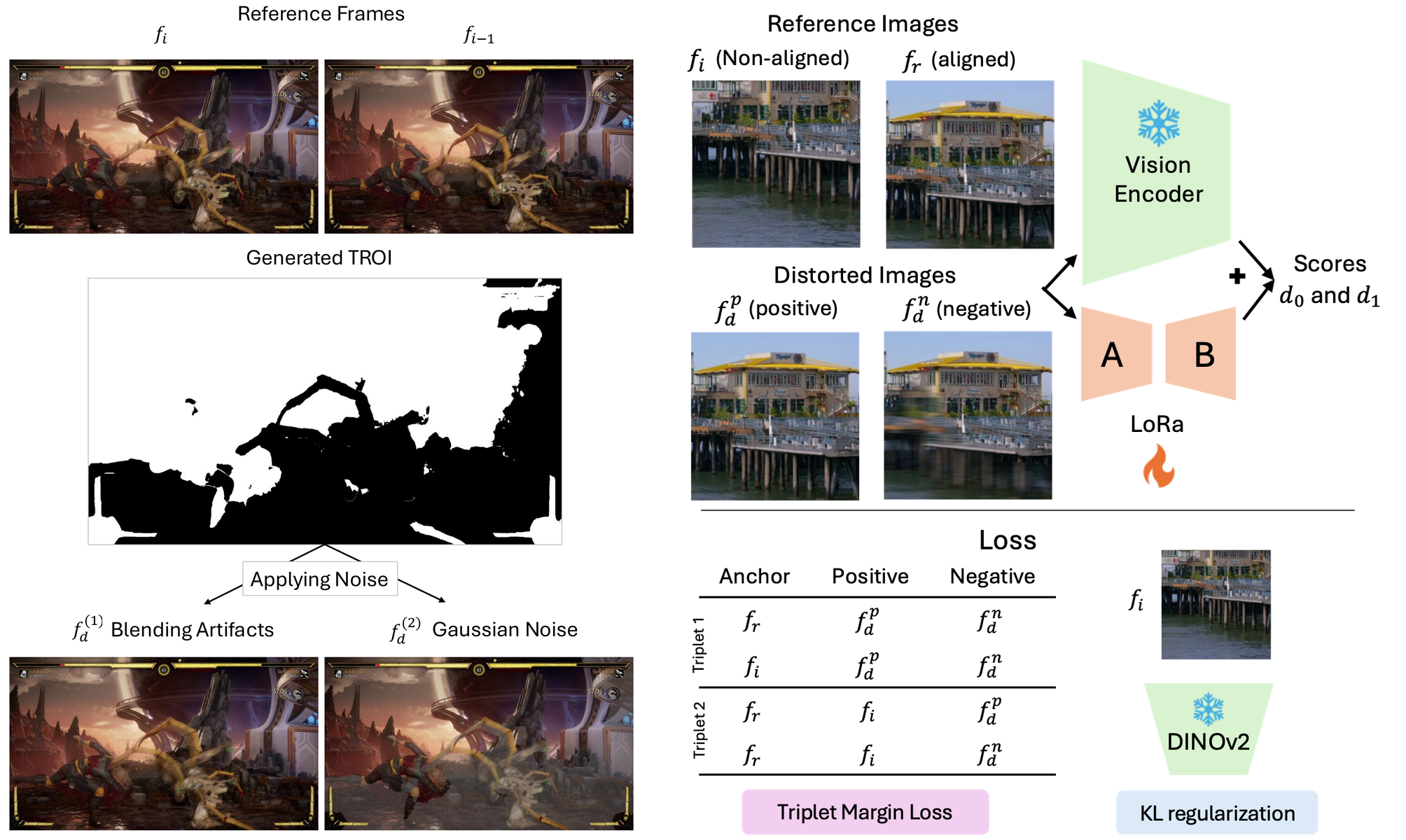
Non-Aligned Reference Image Quality Assessment for Novel View Synthesis
Abhijay Ghildyal, Rajesh Sureddi, Nabajeet Barman, Saman Zadtootaghaj, Alan C. Bovik
IEEE/CVF Winter Conference on Applications of Computer Vision (WACV), 2026
project page  /  paper  /  arXiv  /  code  /  colab  /  dataset

Novel view synthesis renders images from viewpoints that have no pixel-aligned ground-truth reference, which breaks standard full-reference quality metrics. NOVA assesses synthesized views using non-aligned reference images, contributing an NVS quality benchmark and a contrastive, LoRA-tuned DINOv2 metric that better matches human perception.
VideoGameQA-Bench
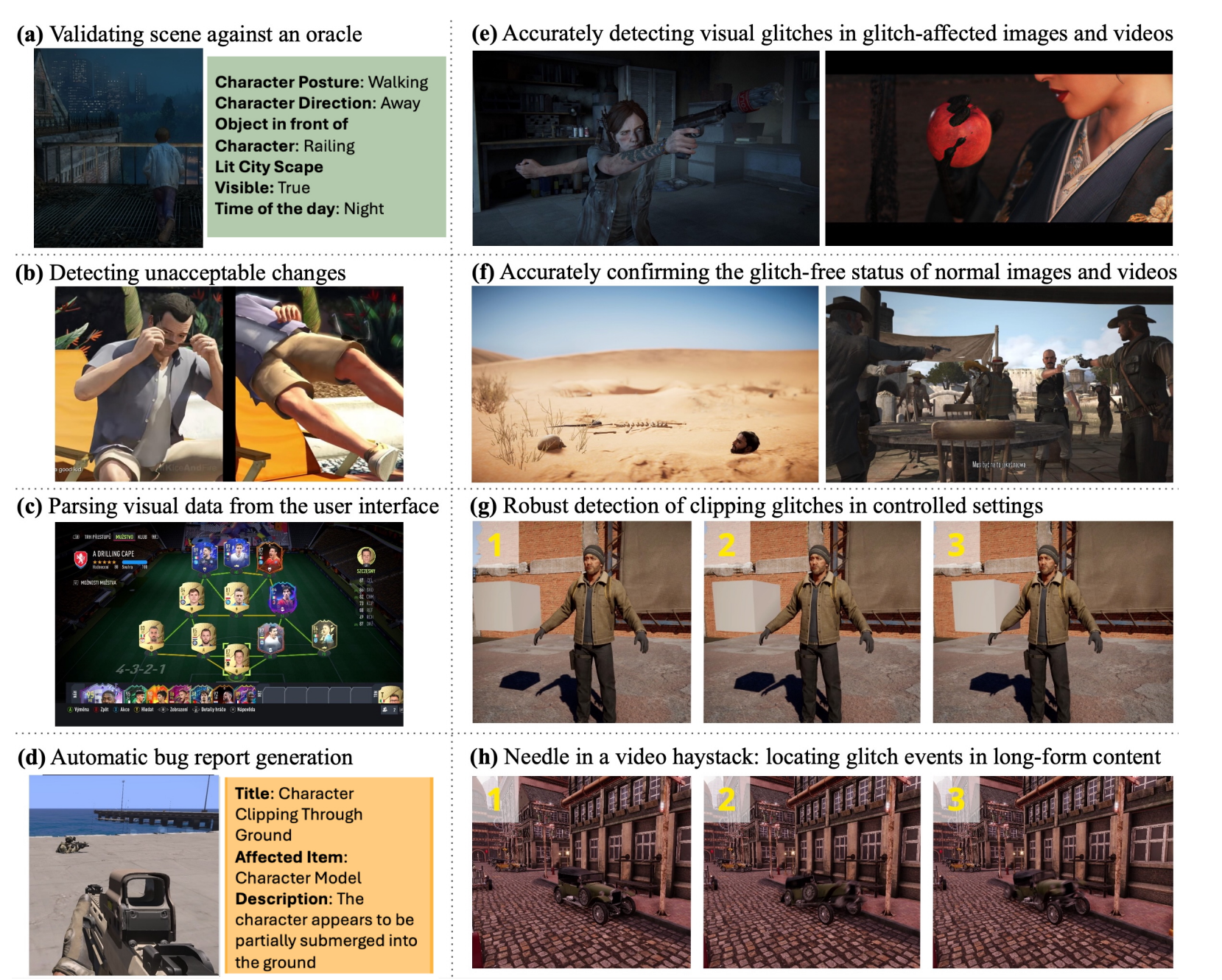
VideoGameQA-Bench: Evaluating Vision-Language Models for Video Game Quality Assurance
Mohammad Reza Taesiri, Abhijay Ghildyal, Saman Zadtootaghaj, Nabajeet Barman, Cor-Paul Bezemer
Conference on Neural Information Processing Systems (NeurIPS), 2025
arXiv  /  project page  /  dataset

A comprehensive benchmark for evaluating Vision-Language Models on video game quality assurance — spanning visual unit testing, visual regression testing, glitch detection, and bug-report generation across both images and videos. It exposes where current VLMs succeed and where they still fall short of reliable, automated game QA.

WP-CLIP
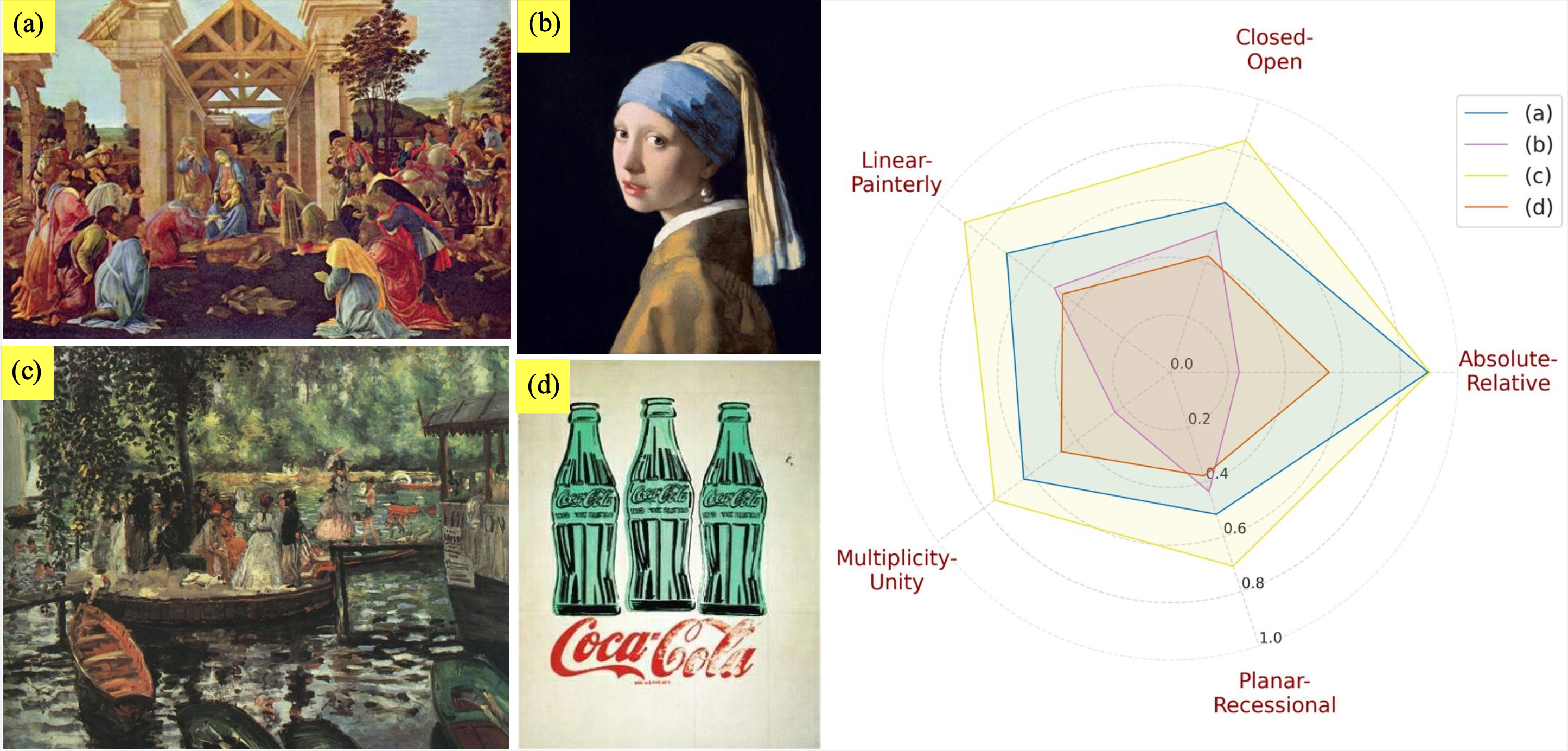
WP-CLIP: Leveraging CLIP to Predict Wölfflin's Principles in Visual Art
Abhijay Ghildyal, Li-Yun Wang, Feng Liu
AI for Visual Arts Workshop (AI4VA) at ICCV, 2025  (Oral)
arXiv  /  code

Wölfflin's principles are five foundational concepts art historians use to describe visual style. We finetune CLIP to predict these principles directly from paintings, offering an interpretable way to quantify and analyze artistic style.

ZS-IQA
Foundation Models Boost Low-Level Perceptual Similarity Metrics
Abhijay Ghildyal, Nabajeet Barman, Saman Zadtootaghaj
IEEE International Conference on Acoustics, Speech, and Signal Processing, 2025
arXiv  /  code  /  bibtex

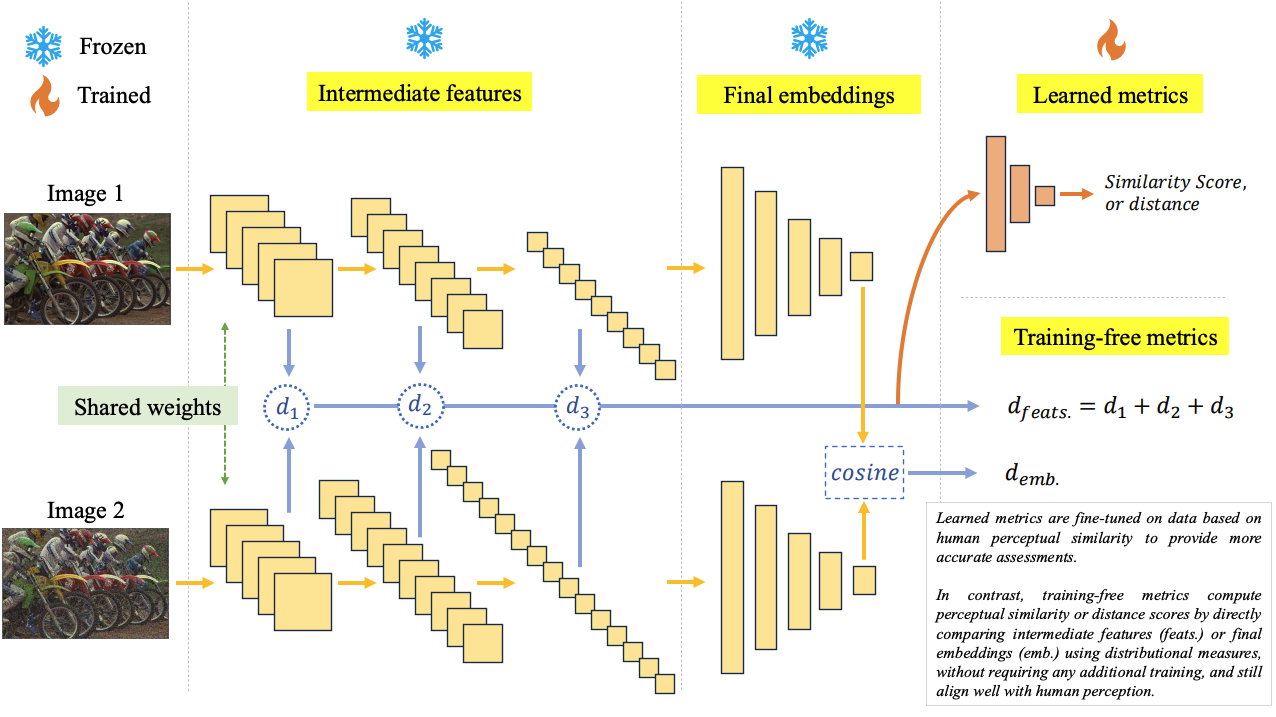
Previous perceptual similarity models using foundation models focus on the final layer or embedding. In contrast, this work investigates the use of intermediate features, which remain largely unexplored in low-level perceptual similarity metrics. We show that intermediate features are more effective and, using simple distance measures in a zero-shot setting, outperform existing metrics.

LAR-IQA
LAR-IQA: A Lightweight, Accurate, and Robust No-Reference Image Quality Assessment Model
Nasim J. Avanaki, Abhijay Ghildyal, Nabajeet Barman, Saman Zadtootaghaj
Advances in Image Manipulation Workshop at European Conference on Computer Vision (ECCV), 2024
arXiv  /  code  /  bibtex

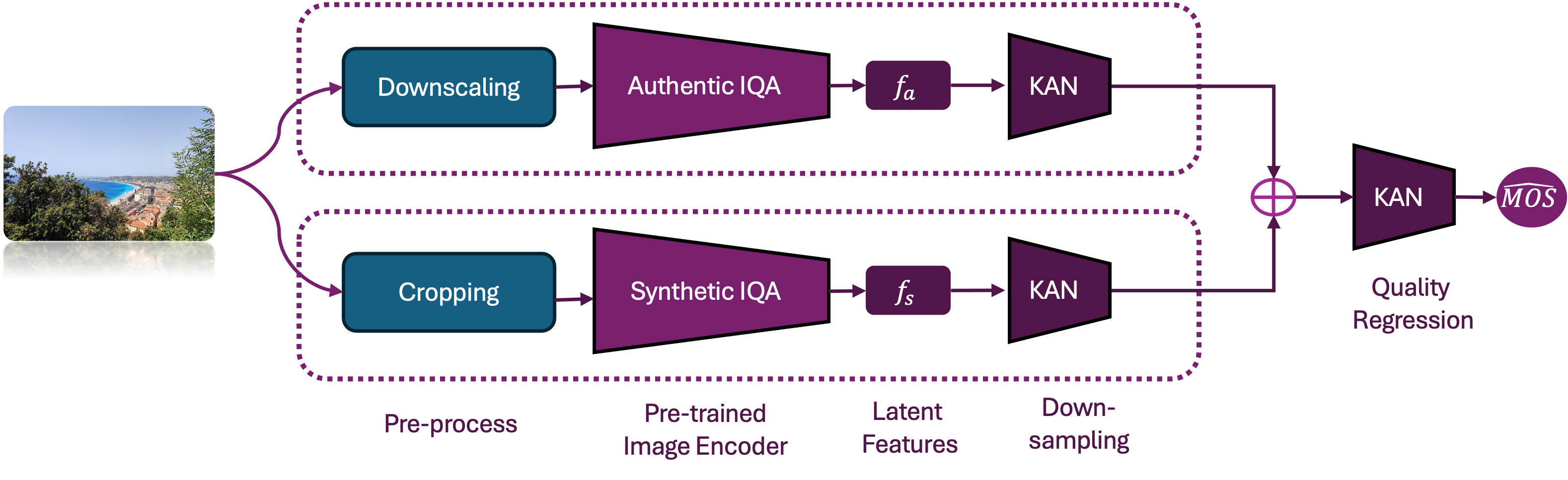
We developed a lightweight No-Reference Image Quality Assessment (NR-IQA) model. It uses a dual-branch architecture, with one branch trained on synthetically distorted images and the other on authentically distorted images, improving generalizability across distortion types. It is a compact, lightweight NR-IQA model that achieves SOTA performance on ECCV AIM UHD-IQA challenge validation and test datasets while being nearly 5.7 times faster than the fastest SOTA model.

Quality Prediction of AI Generated Images and Videos
Quality Prediction of AI Generated Images and Videos: Emerging Trends and Opportunities
Abhijay Ghildyal, Yuanhan Chen, Saman Zadtootaghaj, Nabajeet Barman, Alan C. Bovik
Position Paper, arXiv, 2024
arXiv

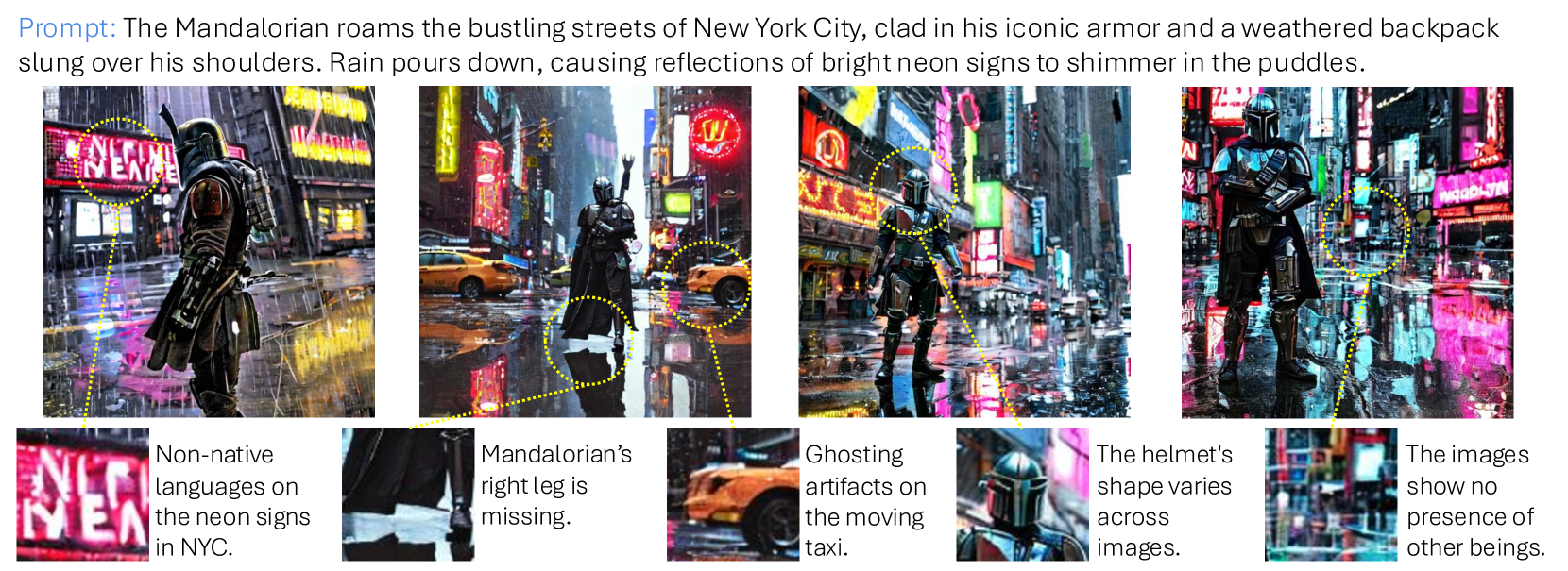
A position paper examining how the quality of AI-generated images and videos is measured today, the distinctive artifacts that generative models introduce, and the emerging trends and open opportunities for perceptual quality metrics designed specifically for generated visual content.

Attacking Perceptual Similarity Metrics
Abhijay Ghildyal, Feng Liu
Transactions on Machine Learning Research (TMLR), 2023
Featured Certification (Spotlight 🌟 or top ~0.01% of the accepted papers)
arXiv  /  code  /  OpenReview  /  bibtex

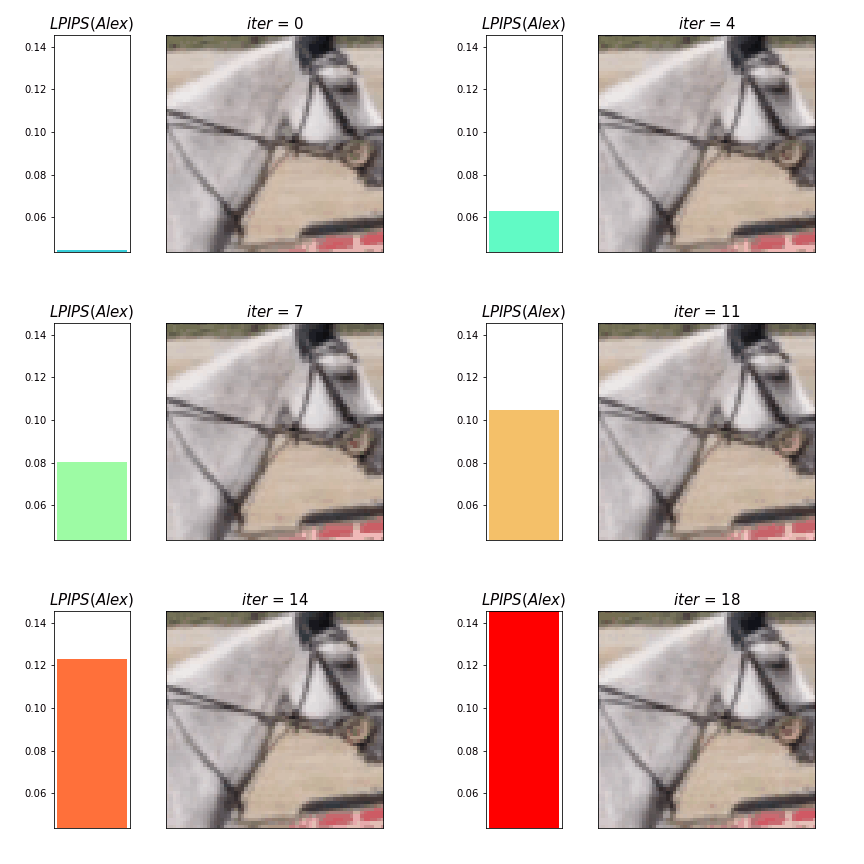
In this study, we systematically examine the robustness of both traditional and learned perceptual similarity metrics to imperceptible adversarial perturbations.

VFIPS
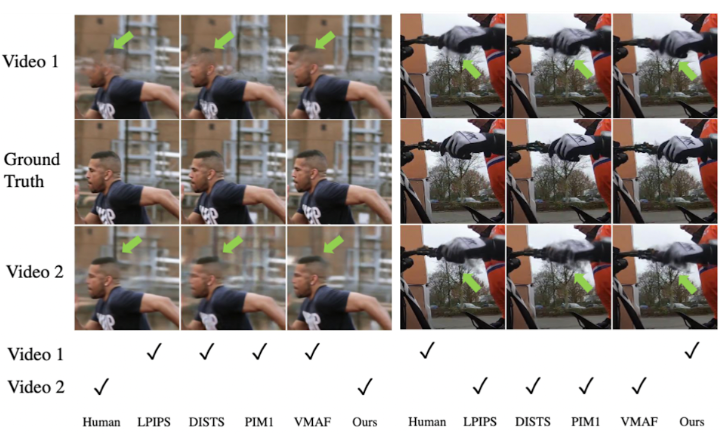
A Perceptual Quality Metric for Video Frame Interpolation
Qiqi Hou, Abhijay Ghildyal, Feng Liu
European Conference on Computer Vision (ECCV), 2022
arXiv  /  code  /  video  /  bibtex

We developed a perceptual quality metric for measuring video frame interpolation results. Our method learns perceptual features directly from videos instead of individual frames.

ST-LPIPS
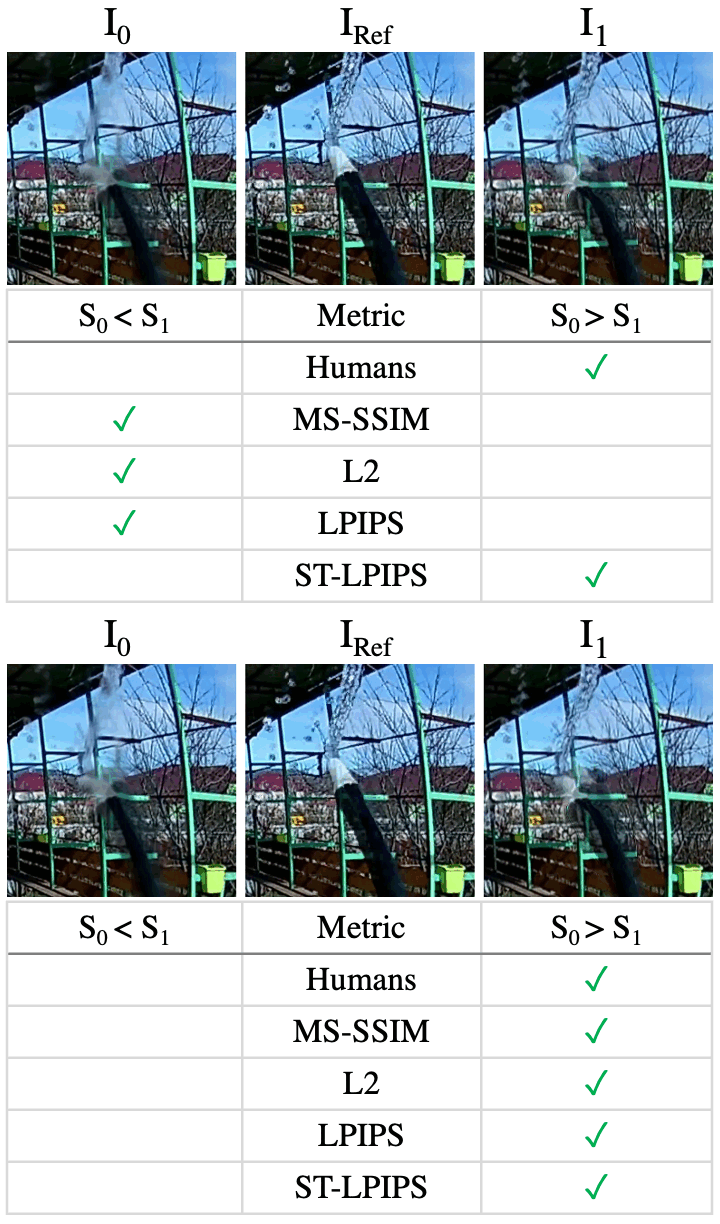
Shift-tolerant Perceptual Similarity Metric
Abhijay Ghildyal, Feng Liu
European Conference on Computer Vision (ECCV), 2022
arXiv  /  code  /  video  /  IQA-PyTorch  /  bibtex

We investigated a broad range of neural network elements and developed a robust perceptual similarity metric. Our shift-tolerant perceptual similarity metric (ST-LPIPS) is consistent with human perception and is less susceptible to imperceptible misalignments between two images than existing metrics.

Education
Experience
Selected Talks
  • "Predicting Wölfflin's Principles in Visual Art using Vision-Language Models"
    AI for Visual Arts Workshop at ICCV Oct'25
  • "Quality Assessment in the era of AI-Generated and AI-Enhanced Content"
    ACM Mile-High Video Conference Feb'25
  • "Foundation Models Boost Low-Level Perceptual Similarity Metrics"
    Video Quality Experts Group (VQEG) Nov'24
  • "Robust Perceptual Similarity Metrics"
    Video Quality Experts Group (VQEG) Mar'24
Services
VQEG
Subjective and Objective Assessment of GenAI Content (SOGAI)
Conference and Journal Reviewer
TPAMI (2024, 2025)
TMLR (2023, 2025)
CVPR (2025)
WACV (2024, 2025)
ECCV (2024)
AAAI (2025, 2026)
ICASSP (2025)
ACM MM (2022)
ACM MMSys (2025, 2026)
IJCNN (2025)
Workshop Reviewer
Women in Computer Vision (CVPR 2023, CVPR 2024, ECCV 2024)
AI4VA: AI for Visual Arts Workshop and Challenges (ECCV 2024, ICCV 2025)
Out-of-Distribution Generalization in Computer Vision (ECCV 2024)
Awards
Teaching
Teaching Assistant
CS 441/541 Artificial Intelligence (Fall'19, Winter'20)
CS 445/545 Machine Learning (Spring'21)
CS 447/547 Computer Graphics (Fall'21)
Numerical Computation (Winter'24)